

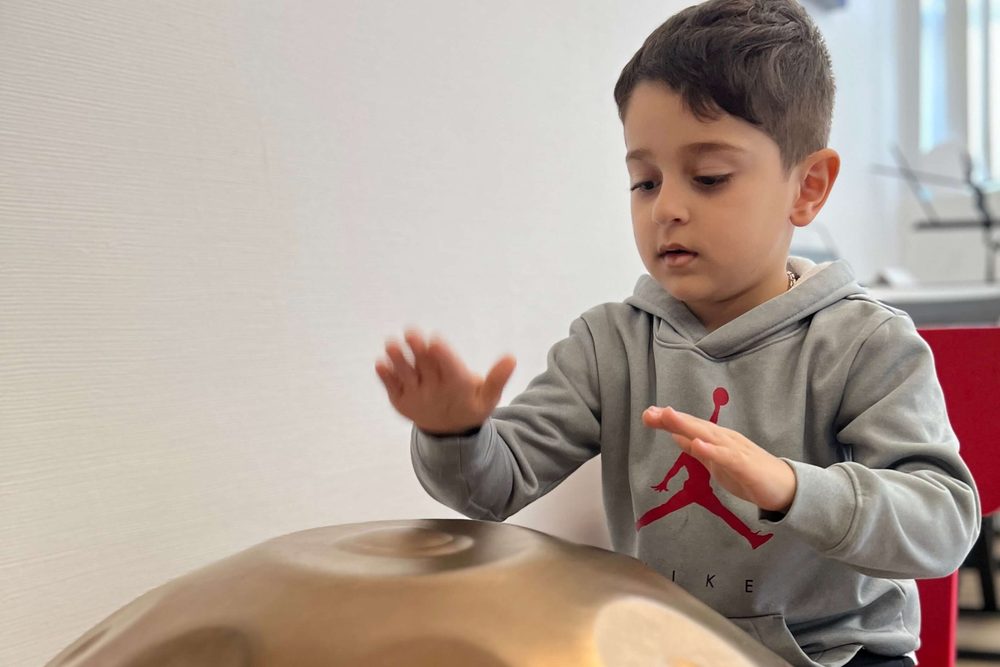
Yes, a handpan can suit children. School-age children can often explore it on their own, while younger ones benefit from an adult beside them. For Bangkok families, a handpan for kids is a welcoming first instrument: it fits short moments between school and family time, and needs no sheet music. Whether it suits your child depends on their readiness.
What is a Handpan and How is it Made?
A handpan is a steel instrument tuned to a musical scale and played with the hands. It descends from the Hang, created in Bern, Switzerland, in 2000, which has seven or eight tone fields around a central note and is played resting on the lap. A handpan is shaped and tuned by hand from a thin steel sheet, usually 1 to 1.2 mm thick. Each tone field is a tuned area that produces one note when tapped: a central note sits in the middle, with the others arranged around it. It rests on the lap or a stable surface, and a light fingertip touch is enough to make it sing.
Why are Children Drawn to Its Sound?
A light tap produces a clear, resonant note that lingers, inviting the child to listen and try another. For a child playing a handpan, this instant response makes musical exploration feel open and rewarding. Children don’t need to know a tune to enjoy hearing the notes answer their hands. Some focus on a single note as it fades; others test a few notes in a row, find a rhythm, or answer a soft sound with a quicker one. Playing can also bring calm moments, such as a quiet turn after school.
What Age Can a Child Start?
There is no strict minimum age. Readiness matters more than age: a child can start when they can sit, focus briefly, and control their hand movements.
Child’s situation Guide Support
Younger than school age : Can sit, focus briefly and tap gently : Adult beside the child
Around 6 to 8 years old : Common starting age : Can often play independently
With younger players, your presence keeps the handpan steady and the session simple.
Does it Suit Small Hands & Short Attention Spans?
Yes. There is no tool to grip and no complex movement to learn: a fingertip tap is enough. Your child can play the notes within easy reach, without stretching. A few taps can be enough: a pause is part of play, not a failure, and your child can come back
later without finishing a tune.
What Should You Look for in a Handpan for Kids?
A smaller kids’ or mini handpan with 8 or 9 notes is a practical first choice. Check for:
- A size your child can sit with comfortably
- A light weight that feels easy to handle
- 8 or 9 notes, for a layout that is easier to take in
- A well-fitting padded case for carrying and storage
Which Scale Lets a Child Experiment Freely?
Choose a scale whose notes sound pleasant in any combination, such as D minor or D Kurd. D Kurd is a natural minor scale (Aeolian mode) in D, letting a child try sequences without building a tune from scratch. A standard 9-note D Kurd has a central D3, surrounded by A3, B♭3, C4, D4, E4, F4, G4 and A4: seven different notes over nine tone fields, some repeated an octave apart. Listen before choosing: play a few notes in different orders and ask whether your family will enjoy hearing this sound often.
How Can Children Learn Without Sheet Music
Children can make music by ear, long before learning notation. Play a short phrase and
invite your child to copy it or answer with their own. Simple activities include:
- Listen and echo: repeat a short sound you play (listening)
- Rhythm game: copy or answer a simple beat (pulse and timing)
- Pattern practice: repeat two or three notes in order (memory and coordination)
- Invent a pattern: swap one note or choose when the pattern ends (creativity)
Keep examples short and don’t correct every missed note: a change in rhythm can be a new idea.
Brief sessions work better than long practice. A simple family routine: choose a comfortable moment, take turns playing a sound, listen and respond, then finish while your child is still engaged. For more structure, online handpan lessons can cover rhythm, coordination, hand independence, melodies, chords, ear training and patterns. Choose ones suited to your child’s age and attention.
Be patient: a child may repeat a favourite sound for several sessions. Progress shows in listening and keeping a beat, not in tunes learned.
How Do You Care for a Handpan in Bangkok’s Heat & Humidity?
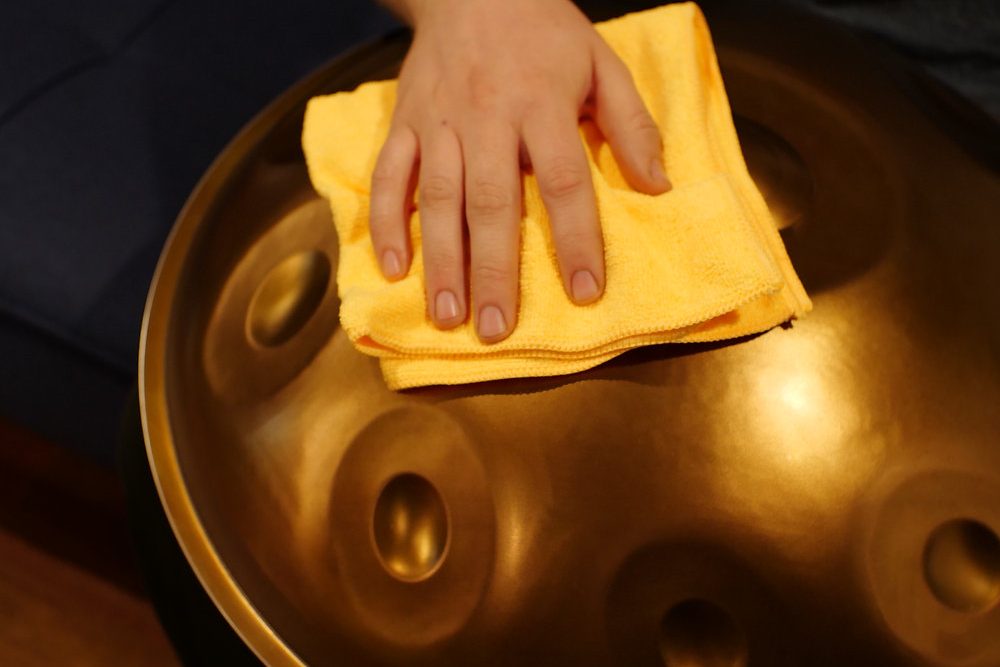
Moisture left on steel can cause rust or stains, especially if trapped in a bag. After every session, wipe off sweat, skin oils, salts, and dust with a soft cloth.
- Dry it fully before putting it in its case
- Keep it away from direct sun and strong heat
- Apply protective oil every 1–6 months in humid conditions, following the maker’s
- directions; oil doesn’t replace wiping
- Play with hands only, never sticks or hard objects, which can dent the steel and affect
- tuning
- Encourage a light touch, as forceful playing can gradually detune it
Could a Steel Tongue Drum be a Gentler First Step?
For a very young child, a steel tongue drum is another option: tongues cut into the steel give clear places to play, usually with small mallets. An adult should supervise a very young child using them. Some families like this start; others prefer a handpan’s hands-on feel.
A handpan can be a rewarding first instrument when its size and your support match your child’s readiness. Let your child hear and try an appropriately sized handpan with you beside them, then decide whether to begin with a kids’ or mini handpan.