



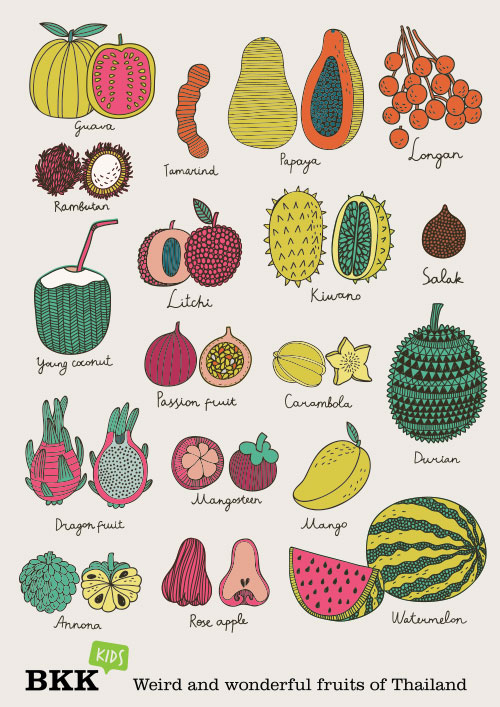
We are definitely spoiled for choice when it comes to local fruits in Thailand – so many weird and wonderful choices, especially during the peak season from May to June. How many of the below have you tired?
Guava (fa-rang) – Available all year round, this fruit derived its name, meaning “white” or “Westerner”, from its origins in tropical America. It’s immensely popular in Thailand and often served with a salt-sugar-chilli dip. Tip: Avoid eating the core, which is filled with lots of tiny seeds and causes constipation.
Tamarind (ma-kham) – Tart, tangy and chewy, the versatile tamarind can be consumed fresh or in candied form; it’s also used in some Thai dishes. Tip: Watch out for the hard, bean-like seeds; also, tamarind is a laxative, so don’t eat too many in one go.
Papaya (ma-la-kor) – Papaya is another highly popular fruit in Thailand, often served with a squeeze of lime juice. There are many varieties but we often see just one of two kinds in the supermarket. Tip: Slice lengthwise, remove seeds and eat with a spoon.
Longan (lam-yai) – Grown extensively in the north of Thailand, longan flourishes from May to June. It’s sweet with a distinctive taste, and can be enjoyed fresh, candied or brewed into a tea. Tip: Longan is considered a “warming” fruit, which has the effect of raising “heat” (or energy) in the body. It’s ideal for those with cold hands or feet, low energy and fluid retention, but it should be enjoyed in moderation.
Rambutan (ngo) – You can’t miss this unusual looking fruit, which is encased in a red, hairy covering. There are several varieties but generally, all rambutan features super sweet flesh. Tip: The meat does not come off the wood-like seed easily; use a knife to help remove the flesh.
Litchi (lin-chee) – Originally from China and widely grown in northern Thailand, litchi offers a sweet and slightly tart taste. It’s got a hard pit in the middle that ranges in size, depending on the variety. Tip: Considered a “warming” fruit, like longan, litchi should be eaten in moderation.
Coconut (ma-phrao) – Coconut water is refreshing, especially when served ice cold. It contains lots of natural electrolytes and it is great for keeping the body well hydrated. Tip: Drink the water directly from the coconut with a straw. You can also eat the flesh of a young fruit; scoop out the tender meat with a spoon.
Kiwano/Gac Fruit (fakh-khao) – A super fruit, gac has a subtle, slightly sweet and refreshing taste, but it is messy to eat. It is often made into a sweetened drink, sometimes mixed with passion fruit juice. Tip: Gac is hard to find. You must visit local wet markets or farmers markets to find it during the peak season towards the end of the year.
Salak/Snake Fruit (sa-lak) – With a spiky skin (kind of like a cactus) that is often hard to remove, salak fruit is deliciously tangy and sweet. In Thailand, it’s often served with a sugar-salt dip. Tip: You can find already-peeled fruit, which is light brown in colour with a smooth texture, from some street-side vendors.
Passion Fruit (sao-wa-rot) – Another super fruit, the sweet and tart pulp of passion fruit can be eaten right out of the fruit with a spoon. It can also be enjoyed as a juice. Its seeds are edible with a nice crunch. Tip: Passion fruit is a great source of fibre – good for countering constipation.
Carambola/Star Fruit (ma-fueng) – With a peak season from October to December, the star-shaped carambola is sweet and juicy with a dash of sourness. It’s excellent for quenching thirst, and is often served with a dry salt-sugar-chilli dip or nam-pla-waan, a thick and savoury dip made with chilli, palm sugar and fish sauce. Tip: As the skin is consumed, soak and scrub the fruit in a water-baking soda mix to remove wax and other residue beforehand.
Durian (thu-rian) – Durian needs no introduction and should be tried at least once, despite its strong, off-putting aroma. You’ll either love or hate its creamy flesh. There are many varieties in Thailand, some of which are highly prized delicacies. Tip: For beginners, try mon-thong durian, with a less pungent smell. Other famed varieties are kan-yao and cha-ni.
Dragon Fruit (kaew-mang-korn) – This unusual-looking super fruit hails from Vietnam but it has gained prominence in Thailand in the past decade or so. In white and purple flesh varieties, it’s packed with nutrients and has a subtle taste, with slightly slimy texture. Tip: Either peel off the thick skin and then cut it into slices, or cut it in half and scoop out the flesh with a spoon.
Mangosteen (mang-khut) – One of our favourite Thai fruits, mangosteen peaks from May to July. Its white juicy pulp is divided into about five to eight segments, some of which will contain seeds. The taste is sweet and tangy. Tip: Cut the purple-red rind laterally and enjoy the fruit right from the peel. Watch out for the sap – it can permanently stain clothing.
Mango (ma-muang) – Depending on the variety, Thai mangoes can be eaten both ripe and unripe. The former includes nam-dok-mai and ok-rong, which are great with sticky rice and coconut cream. The latter encompasses khiao-sa-woei and nang-seam, eaten plain or accompanied by nam-pla-waan, a thick and savoury dip made with chilli, palm sugar and fish sauce. Tip: Stay tuned for the introduction of a purple mango, a cross between local and Taiwanese varieties!
Annona/Custard Apple (noi-na) – Originally from Central America, this delicate fruit is easily broken when ripe. The soft white flesh is sweet and creamy, with lots of nutritional benefits. Tip: Eat the meat with a spoon and spit out the seeds. Seek out noi-na ice cream, a delicious and creamy confection, at Thai restaurants around town.
Rose Apple (chom-phu) – Shaped like a pear, the rose apple can be eaten whole after the hollow end is cut off and its seeds are removed. The fruit from both red and green varieties are crisp and slightly sweet, and they are often a hit with children. Tip: As the skin is consumed, soak and scrub the fruit in a water-baking soda mix to remove wax and other residue beforehand.
Watermelon (taeng-mo) – In Thailand, this beloved fruit, available year-round, comes in watery red pulp or yellow pulp varieties, with lots of small brown seeds. It’s great for quenching thirst and can be made into an icy drink, with or without added sugar. Tip: Watermelon, lime juice, mint leaves and ice go great together as a slushie.
Register your email address here and we’ll notify you when a new article gets uploaded.